
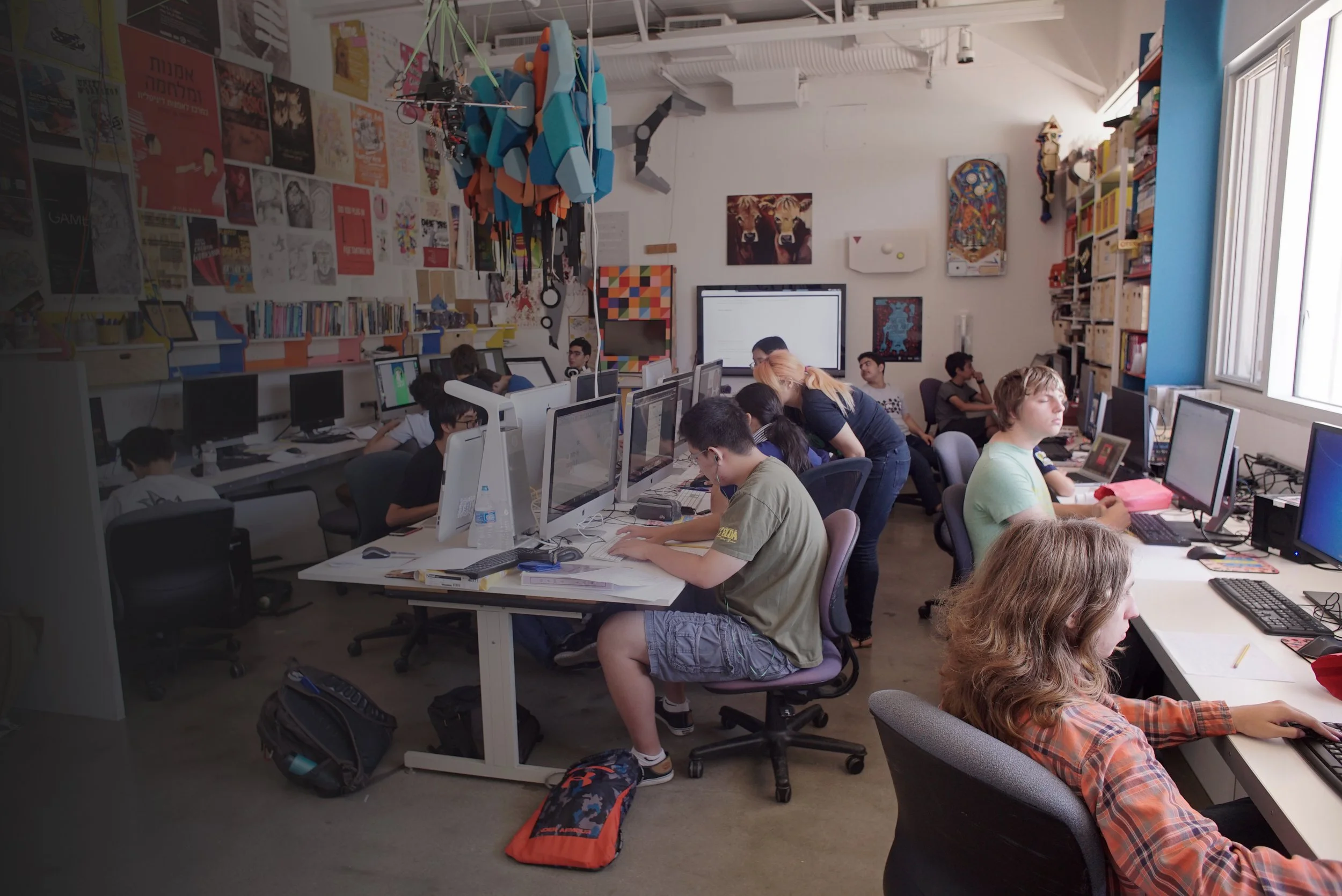
Develop analog and digital games that reflect your creative voice
Game Lab Summer Institute
Learn the fundamentals of compelling game design in our residential or virtual program options for Summer 2026.
The UCLA Game Lab Summer Institute introduces high school students to game-making as a form of artistic practice, teaching them the techniques and tools that will help them develop analog and digital games that reflect their own creative voice and vision. No previous game-making skills are required, but students with an interest in games and in the visual arts will find our institute especially stimulating and rewarding. Students in the program develop a solid aesthetic and technical foundation in various aspects of game design–but just as importantly, they begin learning how to express their own, personal ideas through game-making and game art.
Taught by alumni of the internationally renowned UCLA Game Lab, the three-week program leads students through four, hands-on courses in game development. These workflow-oriented classes focus on:
Learning the fundamentals of game design
Creating compelling game characters
Building game worlds
Programming/coding games
Students who complete the program earn four units of pass/no pass UC college credit, and they leave the program with game art they can include in their college application portfolios. The institute also provides students with a rare opportunity to receive invaluable feedback that will prove useful to academic and career pursuits in game development.
Game Lab Summer Institute Program Overview
2026 Program Dates:
Virtual Program:
June 22 – July 9
Residential Program:
July 12 – 29
Application Deadline (Virtual): June 15, 2026
Application Deadline (Residential): June 30, 2026
-
During the three-week program, students will be introduced to the art and technology of game development through a four-course curriculum.
PLEASE NOTE: Both virtual and residential options are taught through LIVE class instruction and interaction. Attendance is therefore required for every class. For students in the virtual option who live outside the United States, this may mean attending class late at night or early in the morning. Shifting to early/late hours is understandably a challenge, but live attendance is essential to learning in these classes and to overall success in the program.
Our four courses are designed to complement each other, providing students a comprehensive introduction to making games and games art. This includes learning the fundamentals of game design; creating characters and avatars that express personality and identity through animation or movement; building unique and compelling game worlds to navigate or explore; and developing programming skills to create interactive, gameplay experiences.
Game Design: This course will introduce students to the fundamentals of game design, such as creating playable characters, designing conflicts and choices, and giving players compelling motivations and goals. Students will work to create their own tabletop game with a focus on game systems, game flow, creativity, and aesthetics. It is the goal of this course for students not only to produce an original game, but also to develop an understanding of how game design really works, and to explore the potential of games for creative expression.
Character Animation: Videogames give us characters to control, and this course provides an introduction on how to create playable characters through modeling and animation. Students will develop a 2D character or avatar, which they will learn how to bring to life through stylized visualization and movement. This emphasis allows students to learn various aspects of modeling and animation as applied through After Effects, a state-of the-art modeling and animation application.
World Building: Videogames rely on world building to give game environments narrative potential and playful motivation. In this course, students will put the concept of world building into practice by creating a game environment in the Unity game engine (a leading development platform for creating indie/professional games). Students will use multiple environmental elements, such as buildings, plants, terrain, and lighting to create a navigable game world.
Game Programming: Videogames use computer programming or code to express movement and collision, provide spaces for interaction, and capture player input. This course introduces students to the fundamentals of game-related coding in C# while developing a playable videogame in the Unity game engine. Using a creative graphics programming toolkit for creating games, students will build a videogame, playtest the results, and make refinements as part of an iterative design process (a common approach to game design in indie and professional game development).
Your Instructors
All faculty and teaching assistants are practicing game design artists and educators affiliated with the UCLA Game Lab, with extensive experience and expertise in their respective course subjects. Each course will be led by a faculty instructor and teaching assistant, with additional staff to provide support.
-
Age
Students must be 15 years of age or older by June 22, 2026 to participate–and not older than 18 years of age or enrolled full-time in college.
Transcript
You will be asked to upload a high school transcript when you begin the Program Application on the next page. Please be sure to have a digital copy of your transcript before you begin the application.
Prerequisites
There are no course or subject matter prerequisites for these programs. However, students should have a serious interest in art and technology, and be motivated to study and create games and game art.
-
Admission to the program is granted on a rolling basis. Applying at your earliest convenience is highly recommended.
Enrolling in UCLA Game Lab Summer Institute requires three steps:
Complete the program application and pay the program fee—you'll receive a confirmation email with further instructions.
Register as a UCLA student at and pay the $350 non-refundable fee to receive your University ID (UID).
Create a MyUCLA account using your UID, add your student to the course waitlist, and pay remaining fees through Bruin Bill. After completing all three steps, your student is fully enrolled.
-
Virtual Program
June 22 - July 9 (Session A3)
Monday - Thursday for three weeksAll meeting times will take place online (via Zoom) in Pacific Daylight Time (PDT), unless otherwise noted on program schedule and syllabus. Participants must log-in to virtual sessions at the times indicated on the program schedule.
Residential Program
July 12 - July 29 (Session B3)
Monday - Friday weeks 1 and 2
Monday - Wednesday week 3 (last check-out Thursday a.m., July 30)The residential program option provides on-campus, supervised housing for all students–including weekends–starting the first Sunday of the program (residential hall check-in and campus orientation day). Students will be able to walk or take a campus bus to and from their residential hall to classes, and breakfast and dinner in a nearby dining hall are also provided every day (including weekends). Note: Students will need to bring money for lunch every day, which can be obtained at various campus food courts. Complete details about campus life will be provided through an email welcome packet in June.
-
Course
Game Lab Summer Institute is a college-credit program, which means students who successfully complete the program earn 4 units of college credit in the University of California system. The specific course you will be enrolling in to participate in the program is called “Game Design (DESMA 3).”
Grading
Students will be graded on a Pass/No Pass basis upon completion. See University Credit, Grades and Transcripts for more information about academic credit.
In order to successfully complete the program, attendance is absolutely required; only absences excused in advance are permitted. Complete details about successfully completing the program will be found in the Program Handbook, which you will receive after fully enrolling in the program.
-
What visa should international students apply for?
Our Summer Institutes now require an I-20 application and an F-1 visa for international students attending in person. After you add yourself to the waitlist for DESMA 3 (during Step 3 of enrollment), you will receive an email from the UCLA Dashew Center for International Students & Scholars with steps to access the Form I-20 portal and complete the application. Please allow 3-4 weeks after submitting the form to receive your approved I-20. Next, please follow the email instructions to set up an appointment with a local U.S. Embassy/Consulate to formally apply for the F-1 visa. Please note you must begin the I-20 process by May 1. For more information, please visit the UCLA Summer Sessions Website.
Fees and Payment Info
The program fee includes the unit fees for the UCLA coursework offered as part of the program and thus varies by UC student status. In addition to the program fee, students are assessed other campus and administrative fees during the summer.
Virtual Program Fees
Program fee*
Registration fee
Course and Institutional fees**
$1,450
$350
$1,791
Total Fees
$3,591
Residential Program Fees
Program fee (includes housing)*
Registration fee
Course and Institutional fees***
Total Fees
$4,400
$350
$1,791
$6,541
* Refundable until May 15
** Refundable until June 25
*** Refundable until July 16
Note: International students are subject to an additional $1,025 in health insurance and service fees, applied on top of Course and Institutional fees.
Game Lab Summer Institute FAQ
-
PLEASE NOTE: The virtual option consists of LIVE class sessions hosted on Zoom by our faculty and assistants. Attendance at all class sessions is required. For students not in the United States, this may mean attending class late at night or early in the morning. Shifting to early/late hours is understandably a challenge, but live attendance is essential to learning in these classes and to overall success in the program.
Despite the online modality for the virtual option, the curriculum and educational goals of the program remain the same: to deliver a comprehensive, four-course introduction to game making as an artistic practice. These courses will be taught by the same instructors and teaching assistants, and students will be working on mostly the same projects they would complete in an in-person classroom.
To facilitate a virtual studio experience, the program will combine live, instructor-led online class sessions with live lab sessions led by teaching assistants on a daily basis. All instructor-led class sessions also will be recorded and posted each day for students who cannot access the live classroom (due to a technical issue, for example). All of this will be augmented by supplemental resources made available to students through a classroom web portal for each of the four courses. Students will receive a digital welcome packet prior to the summer institute, which will lay out all the details and procedures for online instruction.
-
The residential program requires on-campus housing for all students. There are several reasons for this, including enhanced safety, improved participation and attendance, and enriched collegiate and community experiences. Given the three-week length of the program–and the challenges of daily commuting in Los Angeles–living on campus is simply the best option for in-person instruction.
-
We strongly encourage students with an interest in art and games to consider enrolling in the program. A familiarity with using computer applications and some exposure to computer code is useful but not required. Students are not expected to have a formal background in any of the subjects we teach at the Game Lab Summer Institute.
-
Yes. Students are certainly welcome to use the projects they make in the Game Lab Summer Institute in their own art portfolios and college applications. More broadly, however, we view the program experience as a foundational opportunity–not only to learn some of the techniques and tools for making games, but also to cultivate a passion for developing as a game artist beyond our program.
To get a better sense of the style and diversity of game art projects created by students in our program, please visit our published archive of previous student work.
-
Typically, students create a physical, tabletop game based on their own ideas and experiences, and they develop game art assets such as characters and environments that could be found in a video game. The themes, aesthetics, and generic content of the games are up to the student to decide.
As a rule, we seek to expand students’ ideas of what games can be about, steering them towards non-traditional or personal subjects and away from the more typical game genres and images (such as fantasy and war).
-
This program gives students a comprehensive, hands-on introduction to the work and expertise that go into game creation. Through our four courses, students encounter the full pipeline of game design, both digital and physical. While the program does not go into detail about specific types of careers in the gaming field, it does provide a crucial “first step” for students potentially interested in both commercial and independent game careers.
-
For students enrolled in the virtual option, all class instruction and student work will need to be facilitated through student-acquired hardware. The exact specifications are listed below. In most cases, these requirements are already met by most desktop or laptop computers students already have. Students will be provided access to Adobe Creative Cloud. Instructions to access Adobe Creative Cloud will be available prior to the program start date. Please email the UCLA Game Lab Summer Institute if you have any technical questions at summer.institute@games.ucla.edu.
Desktop/laptop recommended specifications:
CPU: Multicore Intel/AMD processor with 64-bit/ARM-based Apple Silicon processor
GPU: 2GB of GPU VRAM
Microsoft Windows 11 / macOS Ventura (version 13) and later
RAM 16GB recommended
20 GB of available hard-disk space; Additional disk space for disk cache (10 GB recommended)
Software:
Adobe Creative Cloud (included): Instructions will be provided in June
Unity (free)
For students in the residential option, all hardware and software will be provided, but students may wish to bring a mobile phone (for scanning hand-drawn art) and/or a drawing tablet (if they have one).
-
All completed game art projects are included in an exhibition at the end of the institute—either published on a gallery-styled website (for the virtual option) or installed in a professional-level gallery (for the commuter option). Exhibition details will be communicated to parents and students in advance.
In addition, we encourage students to save their own files throughout the institute, so that they may continue to develop or exhibit their projects, if they wish, after the institute is over. But as a backup, the institute will retain the final version of all submitted student files, which can be made available to students for downloading upon request.
-
The courses are built around daily lesson plans and work assignments, so students should expect to submit or update their work each day to an online form or folder. However, if students miss online class sessions (either live or recorded), or fall behind for any reason, instructors and teaching assistants may ask students to put in some extra time to catch up with overall course progress. Falling too far behind and delinquent assignments may result in a Not Pass grade.
Still have questions?