
Design Media Arts Summer Institute
Create a portfolio-ready body of work in a cutting-edge design media arts department
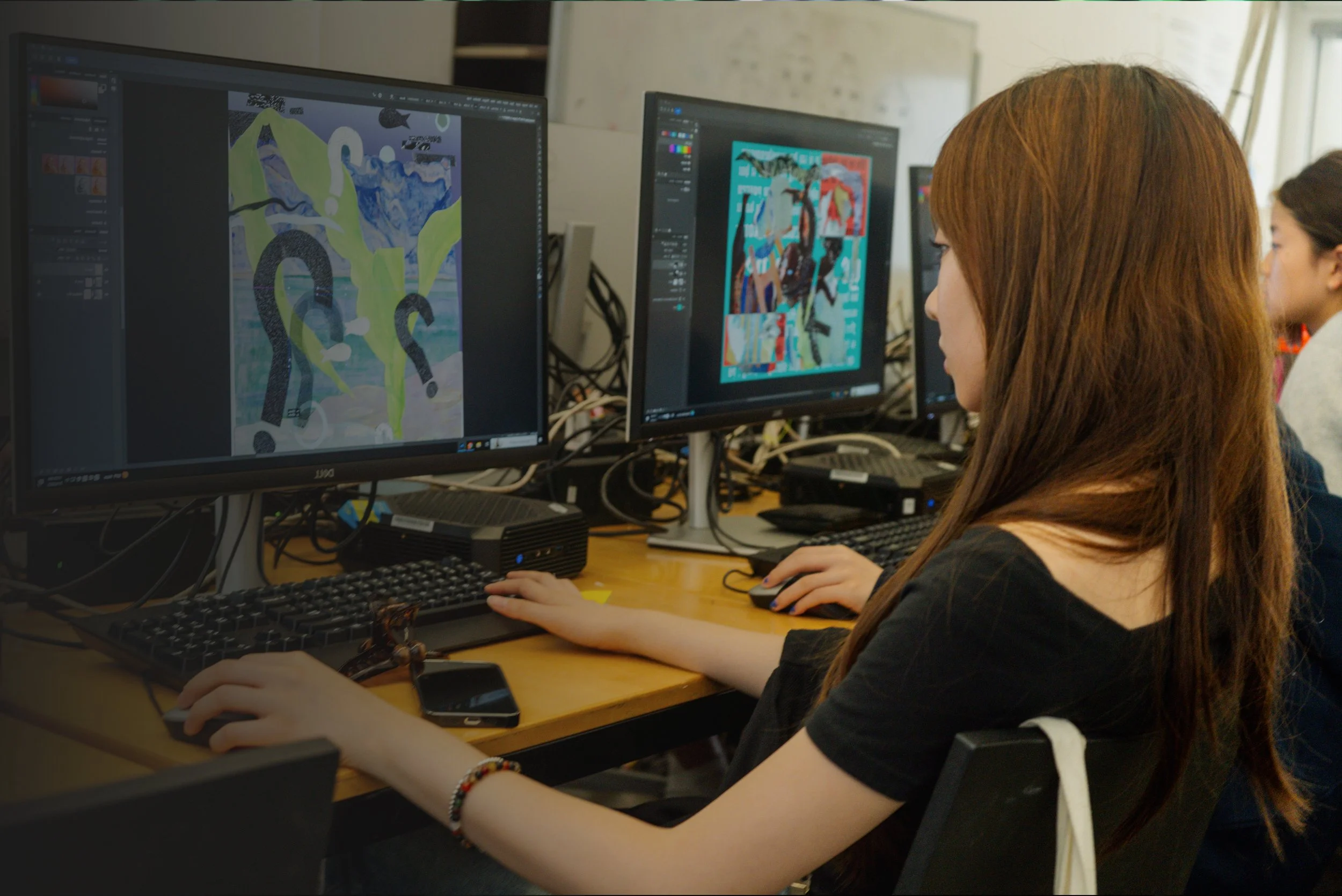
The Department of Design Media Arts (DMA) at UCLA is one of the nation’s top design media arts department offering a comprehensive, multidisciplinary education in media creation, which fosters individual exploration and innovative thinking. Geared specifically for high school students, the department offers the DMA Summer Institute, a three-week program with morning and afternoon classes introducing design practices in the contexts of 2D Image, Net Art, 3D Worldbuilding, and Motion Graphics.
Two versions of the institute are offered: an in-person experience and a virtual/online program. These programs are identical in curriculum design, lesson objectives, and hands-on faculty guidance and support. The program is taught by professionally trained and well-experienced instructors using the most current software and technology. It culminates in a final exhibition and the creation of a portfolio-ready body of work that students may include in their college applications in related fields. It also provides students with a rare opportunity to sample college life in a cutting-edge design media arts department, while earning four units of pass/no pass UC credit.
Apply design practices and your own innovative thinking to multimedia projects
Design Media Arts Summer Institute Program
2026 Program Dates:
Residential Program:
June 21 – July 8 (Session A3)
Virtual Program:
July 13 – July 30 (Session B3)
Application Deadline (Residential): June 15, 2026
Application Deadline (Virtual): June 30, 2026
-
The DMA Summer Institute curriculum is based on materials covered in the department’s undergraduate curriculum. Each class is taught by one instructor and one program assistant; class size is limited to a maximum of 25 students.
Students explore a variety of media examining different practices and design methods applied to the domains of 2D image, Net Art, 3D Worldbuilding, and Motion Graphics. Broadly addressing a common theme, all four classes contribute to the creation of an integrated, multi-media exhibition at the end of the program.
2D IMAGE: Students explore the enduring power of the image through a series of fun and fast-paced exercises for print and digital media. Students develop their own workflow and visual vocabulary while honing their skills in graphic design and typography. Each project integrates foundational principles of design such as form, data, composition, hierarchy, and creative intent.
NET: This course explores online networks as a medium for creative expression and artistic intervention. Through hands-on tutorials, students study the web in the traditions of interactive art, activism, and creative coding. Using techniques like collage and appropriation to reimagine the browser window, students critically engage the aesthetic and social potential of digital connectivity.
WORLD: Game engines originally developed for mass entertainment offer an exciting mode of interactive storytelling. Virtual spaces can immerse us in striking imagery and evoke complex emotions. In this course, students learn the basics of Unity and 3D modelling, while practicing "worldbuilding" as a form of visual narrative, playfulness, and participatory experience.
MOTION: From cinema and television to music videos and animation, motion is an essential property of time-based media. Students explore technical and experimental approaches to cinematography, animation, editing, and sound, gaining an understanding of video-making and motion graphics as powerful tools for storytelling and communication.
The program syllabus is subject to change. Enrolled students will be given updated materials closer to the program start date.
-
Age: Students must be 15 years of age or older by June 22, 2026 and not older than 18 years of age or enrolled full-time in college.
Transcript: You will be asked to upload a high school transcript when you begin the Program Application. Please be sure to have a digital copy of your transcript before you begin the application.
Prerequisites: There are no course or subject matter prerequisites for these programs. However, students should have a serious interest in the course material and be motivated to study and work hard.
-
The program has application requirements for admission. Applications are reviewed and admission to the program is granted on a rolling basis. Eligible applicants who successfully submit all requirements will be reviewed and notified via email of an admission decision within three weeks of submitting an application. Applying at your earliest convenience is highly recommended.
Applicants are required to provide an unofficial transcript from grade 9 to present. If your school transcript utilizes a different grading system, please submit your transcript as is. If available, please attach a translation/equivalency guide.
INTERNATIONAL STUDENTS: a transcript refers to your complete secondary academic record. Click here to learn more about converting your grades into a US-based GPA.
Enrolling requires three steps:
Complete the program application and pay the program fee—you'll receive a confirmation email with further instructions.
Register as a UCLA student at and pay the $350 non-refundable fee to receive your University ID (UID).
Create a MyUCLA account using your UID, add your student to the course waitlist, and pay remaining fees through Bruin Bill. After completing all three steps, your student is fully enrolled.
-
Residential Program: June 21 - July 8 (Session A3)
The Design Media Arts Summer Institute is a residential program with supervised housing for all students–including weekends–starting the first Sunday of the program (residential hall check-in and campus orientation day).
Students will be able to walk or take a campus bus to and from their residential hall to classes.
Breakfast and dinner in a nearby dining hall are also provided every day (including weekends).
Note: Students will need to bring money for lunch every day, which can be obtained at various campus food courts. Complete details about campus life will be provided through an email welcome packet in before the program start date.
Virtual Program: July 13 - July 30 (Session B3)
All meeting times will take place in Pacific Daylight Time (PDT), unless otherwise noted on program schedule and syllabus. Participants must log-in to virtual sessions at the times indicated on the program schedule.
-
Coursework
Design Media Arts (DESMA) 5; 4 units
Grading
Students will be graded on a Pass/No Pass basis upon completion. See University Credit, Grades and Transcripts for more information about academic credit.
In order to successfully complete the program, students must not have more than 1 excused or unexcused absence.
-
What visa should international students apply for?
Our Summer Institutes now require an I-20 application and an F-1 visa for international students attending in person. After you add yourself to the waitlist for DESMA 5 (during Step 3 of enrollment), you will receive an email from the UCLA Dashew Center for International Students & Scholars with steps to access the Form I-20 portal and complete the application. Please allow 3-4 weeks after submitting the form to receive your approved I-20. Next, please follow the email instructions to set up an appointment with a local U.S. Embassy/Consulate to formally apply for the F-1 visa. Please note you must begin the I-20 process by May 1. For more information, please visit the UCLA Summer Sessions Website.
Fees and Payment Info
The program fee includes the unit fees for the UCLA coursework offered as part of the program and thus varies by UC student status. In addition to the program fee, students are assessed other campus and administrative fees during the summer.
Residential Program Fees
Program fee (includes housing)*
Registration fee
Course and Institutional fees**
Total Fees
$1,450
$350
$1,791
$6,541
Virtual Program Fees
Program fee*
Registration fee
Course and Institutional fees***
Total Fees
$4,400
$350
$1,791
$3,591
*Refundable until May 15
** Refundable until June 25
*** Refundable until July 16
Note: International students are subject to an additional $1,025 in health insurance and service fees, applied on top of Course and Institutional fees.
Design Media Arts Summer Institute FAQ
-
Whether you’re brand new to design media arts or already have experience, you’re welcome here. Students of all backgrounds are encouraged to apply.
-
Students typically work on their own projects which will be valuable for those who will need a portfolio for college applications, but some creative processes will be collaborative throughout the program.
-
Students will be asked to create new projects but they are welcome to bring old or ongoing projects for feedback from the course instructors and teaching assistants.
-
We recommend students bring a USB flash drive with at least 256 GB storage capacity to save their projects. Students should label their flash drive with their name in case it is misplaced during the program. Other materials include a notebook, pen, and pencils for sketching and storyboarding.
Laptops will be provided by the program for classroom use only, so students do not need to bring their own.
Still have questions?